Managers juggle a wide range of responsibilities, and there often aren’t enough hours in the day to tackle everything. In the rush to meet deadlines, attend meetings, push projects forward, and keep stakeholders informed, it’s easy to default to focusing on “the work.”
While those tasks are important, there’s a problem: most of them revolve around the manager, not their team. The core role of a people leader is to provide direction, support, and guidance so the team can succeed together. When managers deprioritize their people, they miss a critical part of their job. In fact, McKinsey found that middle managers spend up to 40% of their time on tasks unrelated to managing people.

Managers juggle a wide range of responsibilities, and there often aren’t enough hours in the day to tackle everything. In the rush to meet deadlines, attend meetings, push projects forward, and keep stakeholders informed, it’s easy to default to focusing on “the work.”
While those tasks are important, there’s a problem: most of them revolve around the manager, not their team. The core role of a people leader is to provide direction, support, and guidance so the team can succeed together. When managers de prioritize their people, they miss a critical part of their job. In fact, McKinsey found that middle managers spend up to 40% of their time on tasks unrelated to managing people.
Reframing The Role of The Manager: Being a Developer of Talent
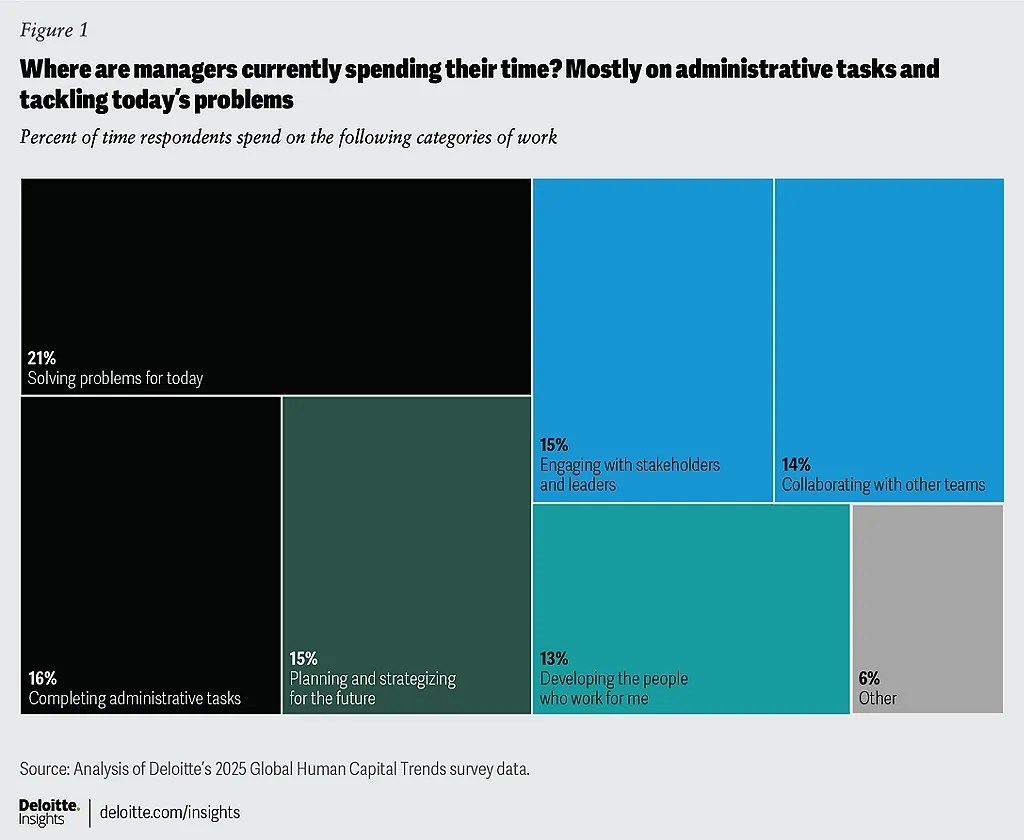
Source: Deloitte Human Capital Trends 2025
One of the most overlooked but impactful actions a manager can take is to develop the talent they already have. Many organizations invest heavily in finding the right people, but far fewer invest the time and energy required to help those people grow once they’re on the team.
The reality is, we rarely hire someone solely for what they can do today. While that is the baseline, we also hire them for the capacity to learn and the potential of what they could do in the future. But that potential doesn’t develop on its own. While some of us may have some highly motivated employees, and certainly formal learning and development plays a role, the day to day work of unlocking the potential and capacity of employees starts with managers.
As a leader, you play a critical role in helping your employees develop and grow. This is not just so they can perform in their current role, but so they can expand their capabilities, take on more responsibility, and achieve their own career goals.
On the surface, this may seem like another responsibility to the list of responsibilities for managers. But developing talent isn’t just another task. It’s a force multiplier for impact. It may take time, but the investment pays off. When you develop your people, you can
- Reach your objectives faster
- Build the skills of your team (to expand your team’s scope and capabilities)
- Unlock greater engagement and ownership within team members
- Create more capacity – freeing yourself up to work on other work
- You create more capacity by freeing yourself up to focus on higher-leverage work.
Think of talent development as the strategy that helps everyone win. Your team becomes more effective, more confident, and more invested. And you, as a leader, expand your influence and capacity by growing the people around you.
Developing Talent Through Practices of Development
Deloitte research shows that effectively developing your direct reports can boost their performance by as much as 27% and make them 1.5 times more likely to exceed their goals Further, 67% of employees in our 2025 survey say that their manager knows best what motivates them. But how do managers find time to do this, or learn how to do this and get started?
The good news is that developing talent doesn’t require massive overhauls or hours of dedicated time; it’s about consistently making small, intentional investments in your people. I call these “practices of development” because they are practices. Practices like offering feedback after a meeting, coaching through a challenging task, or discussing career aspirations can have a powerful, cumulative effect. These small actions build trust, confidence, and skills in your employees. While developing talent through practices of development does require an investment of your time, the returns compound over time.
Some examples of these practices of development include:
- Using time with employees (ex: 1:1’s) to get them to reflect on their work
- Structuring new tasks or projects in ways that align to the strengths and talents of your team members
- Bringing a team member to a meeting with you where they can observe, and then connecting with them afterwards to debrief with them on what happened and what they learned
- Pairing a team member up with a more experienced team member so they can “shadow” that team member and learn from them
- Creating containers and spaces that allow your employees to share knowledge and strengths with one another
- Providing opportunities for your team members to “practice” specific tasks, actions or activities, to help them gain the “sets and reps” they need to build knowledge and skills.
Most of these actions and activities are tasks and actions that you can incorporate into your existing workflow and work. While these may seem like small actions, doing these consistently and repeatedly over time is often what can help your employees gain the skills, opportunities and experiences they need to do their jobs effectively, and in many cases, expand their scope of work because they are actively developing new skills and knowledge which allows them to take on more responsibility. (For more on practices of development, see my previous post)
Self-Determination Theory – Unlocking Motivation By Developing Talent
While this may sound great in theory, it’s also important to recognize some of the underpinnings of individual motivation for why this can be so important. To do this, we’ll draw on some basic psychological concepts, including self-determination theory.
Self-determination theory is a psychological framework developed by Edward Deci and Richard Ryan that explains human motivation and personality. At its core, SDT posits that people are most motivated, engaged, and fulfilled when three basic psychological needs are met:
- Autonomy – the need to feel in control of one’s actions and decisions.
- Competence – the need to feel effective and capable in one’s activities.
- Relatedness – the need to feel connected to others and a sense of belonging.
Said another way, people are motivated by autonomy, mastery, and connection. And when we as leaders create conditions for them to achieve those goals, that’s where they start to really flex their skills, abilities and effort.
Self-determination theory treats employees as human beings and adults, and when you work and operate like this, you are going to empower and put people in positions to do the job that you hired them to do, and use the innate talent and skills that they have. Companies spend so much time trying to hire the best talent, but often don’t allow their employees to use the same skills that they hired them to use.
When you operate from a mindset of self-determination theory as a leader, you believe that your employees (many of whom you may have personally hired) have the capability to do the work, or the capacity and potential to learn how to do the work that needs to be done. This is a much more open, growth-oriented and expansive way to think about how to develop people.
Contrast this with a manager or leader who doesn’t think like this, and instead believes the opposite – who would you rather work for as an employee? And knowing that, how does that influence how you want to operate as a manager or leader?
Conclusion: Unlocking Discretionary Effort Through Becoming a Developer of Talent
In my conversations with employees across industries and functions, one thing has become increasingly clear: work just isn’t very fun right now for a lot of us, and for good reason.
Many industries are navigating constant change, disruption, and uncertainty. People are feeling the effects not just professionally, but personally and within their communities. But here’s the reality: even amid this dissatisfaction, companies are facing serious, complex challenges that must be solved if they want to survive and thrive in today’s world of work. And it’s hard to solve hard problems when large portions of your workforce feel disconnected, overwhelmed, or unmotivated.
There’s a concept in psychology called discretionary effort, which is the extra energy, creativity, and commitment employees choose to give when they feel motivated and empowered. Discretionary effort is what helps teams go the extra mile, solve hard problems, and innovate.
Right now, that kind of effort might feel harder to come by. But becoming a developer of talent could be your best path forward. When you invest in your people, and when you give them opportunities to learn, grow, and stretch in a supportive environment, you signal trust, belief, and possibility.
Talent development isn’t a separate job from managing, it is the actual job. It’s how managers achieve goals, build stronger teams, and create capacity for what’s next. And the good news is, it doesn’t require sweeping changes. Through small, consistent practices (like the ones mentioned) managers can create the conditions where people thrive.
So while the challenges of work aren’t going away anytime soon, the path forward is clear: support your people, and they will support the work. Develop your talent, and you develop your impact.